Central to it is the Vertical Gas Corridor (VGC) (Figure 1),with links to transport gas from Revythousa and Alexandroupolis to Ukraine and all the countries in between, placing Greece at the centre of it.
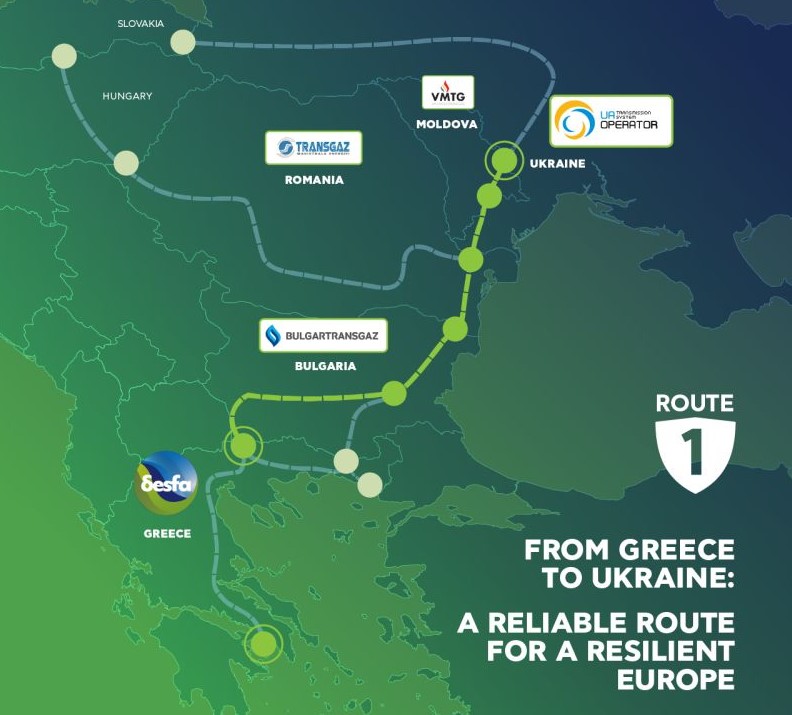
Figure 1: The Vertical Gas Corridor
VGC is a long-term strategic project, the significance of which will increase once all Russian gas flows to Europe cease by the end of 2027.
But a weak market response to capacity auctions in January prompted questions about its viability.
Short-term issues
In the short-term geopolitical concerns resulting from President Trump’s erratic policies towards Europe, regulatory uncertainties emanating from EU’s decision to end all imports of Russian gas -including from TurkStream- and the mounting concern about EU’s increasing dependence on US LNG weigh heavily on new commitments to enter into longer-term gas purchase contracts.
Such uncertainties will become clearer as we approach 2027.
However, one of the reasons that contributed to the weak market response to the recent auctions are high transit tariffs charged by countries through which VGC passes, in comparison to the northern route through Lithuania and Poland.
DEFSA and operators from the other countries are working together toclose the gap and overcome this problem.
Theseconsultations should eventually lead to an agreed regulatory framework that will govern the operation of VGC, essential to ensure its reliable and effective operation.
EU commitments and US support
In the meanwhile, the US has reconfirmed strong support for VGC and Greece’s role in this and has asked the EU to do the same.
This support is likely to be stressed during the state visit by President Trump to Greece, being organized by the USambassador to Greece, Kimberly Guilfoyle. She has expressed strong support for VGC, describing it as “an essential, strategic project for strengthening European energy independence and regional security.”
Guilfoyle stated that the USis ready to supplyreliable US gas through VGC and has been working behind the scenes to advance the realization of the corridor and secure the necessary infrastructure.
Support is also forthcoming from the EU that sees VGC as key to severing dependence on Russian gas, but also in support of its trade agreement commitment to buy US energy products.
The meeting of the energy ministers of the countries involved in the project with the US Secretary of Energy, being planned in Washington on 24 February, is expected to be a crucial milestone in taking the project forward.
Longer-term role
EU natural gas utilization has entered a period of structural decline as REPowerEU and the new 2040 climate targets are being implemented. Current estimates suggest that EU gas demand could fall from approximately 335 bcm in 2025 to as low as 117 bcm by 2040.
Even though this may be the trend in western Europe, it does not reflect the evolving energy needs of central and southeast Europe (CSEE).
In addition to the replacement of Russian gas, based on recent studies use of natural gas for power generation in the CSEE region is likely to more than double from about 21GW now to as much as 50GW by 2040 due to ditching lignite and carbon, as well as proliferation of AI and data centers. That will require as much as 25-30 bcm/yradditional gas.
This is on top of the 20-22 bcm/yr CSEE will require to replace Russian gas after 2027.Clearly, future demand for gas in the region will be quite substantial.
These quantities cannot be delivered through existing gas supply routes to the region through the Poland and Lithuania northern route, that is limited to 10-12 bcm/yr export capacity, making VGC an important part pf the gas infrastructure needed to ensure future gas supply security to CSEE countries.
Where will this gas come from
The primary supply of gas to VGC will be from the US. US LNG capacity in 2025 was over 150 bcm and is expected to reach 266-300 bcm by 2030 and 360-410 bcm by 2040. Plentiful and reliable supply and always on the look-out for new markets. Through this, the US can guarantee the gas supply volumes VGC may require.
Despite concerns, that the EU is becoming too dependent on US LNG, its options to source gas from other suppliers are quite limited.
VGC could also transport gas from Turkey and Azerbaijan and probably will in small quantities, based on current production. Larger gas quantities through this source require development of new gasfields and upgrading of the Southern Gas Corridor infrastructure, both costly undertakings. With EU buyers reluctant to enter into long-term deals, this is unlikely tohappen any time soon, leaving the US as the main supplier.
Hope for the future
The strong response, early February, to DESFA's annual auctions for the reservation of LNG regasification capacity for the period 2026–2040 at Revythousa, are an encouraging sign about the future of gas in the region. These are long-term commitments that reconfirm Revythousa’s role for gas supply of both Greece and the wider region.
In addition, measures are being undertaken by the EU and regional operators to make VGC competitive by 2027. These include tariff harmonization to create a single competitive product, infrastructure debottlenecking to increase capacity, regulatory enforcement and hydrogen readiness to qualify for EU green subsidies.
The US Development Finance Corporation (DFC) has also expressed interest in funding VGC, bringing in US technology and financing. Thiswould lower the debt burden on local operators that would otherwise be passed to consumers through higher tariffs.
All interested parties, regional operators, the US and the EU, are cooperating to make VGC both physically capable and commercially competitive by 2027.
*Dr Charles Ellinas, @CharlesEllinas
Councilor
Atlantic Council