India’s imports from Russia could drop by 40% from January levels to around 600,000 barrels a day, according to a scenario from Rystad Energy. Much of the displaced cargoes are now heading east, spurring a price war with Iranian suppliers that have long been favored by China’s private refiners.
Russia’s Urals grade is selling at around $12 a barrel below ICE Brent, according to traders familiar with such deals, compared with a $10 discount last month. Iranian Light is going for as much as $11 less than the global benchmark, they said, asking not to be named as they’re not authorized to speak to media. That’s widened from $8 to $9 in December.
The independent Chinese refiners, known as teapots, have historically acted as the oil market’s pressure valve, absorbing barrels shunned by others. But their capacity is finite, given they only account for around a quarter of the country’s processing capacity and are also subject to government-set import quotas.
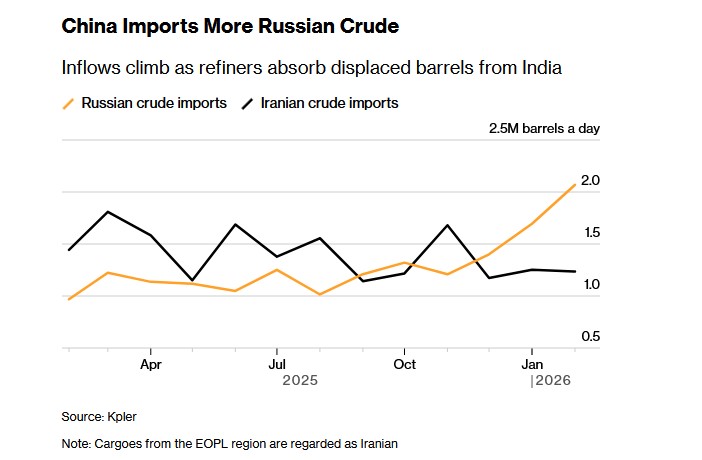
With China unable to fully soak up the displaced crude, unsold oil is piling up in Asian waters and Russia and Iran are running out of options. The Kremlin has already been forced to curb output, depriving it of funds for its war in Ukraine. Iran, meanwhile, is trying to ship as much oil as it can as it girds itself for a potential attack by the US.
“Chinese private refiners cannot take in much more as their capacity is likely maxed out,” said Jianan Sun, an analyst at Energy Aspects, pointing to sanctioned barrels building up in both onshore and offshore storage.
The major Chinese state-owned refiners have traditionally avoided Iranian crude and have, more recently, largely absented themselves from the Russian trade as well.
So far, it looks like Iran is taking a hit as Russia muscles in on the market. Deliveries of Russian oil to Chinese ports rose to 2.09 million barrels a day in the first 18 days of February, vessel-tracking data compiled by Bloomberg show. That’s a roughly 20% increase from January and a jump of around a half from December.
By contrast, Iran has exported about about 1.2 million barrels a day to China so far this year, down around 12% from the year-earlier period, according to Kpler.
The data intelligence firm estimates there are now almost 48 million barrels of Iranian oil at sea, up from about 33 million in early February. Most of the increase is happening in the Yellow Sea and Singapore Strait. Meanwhile, there are around 9.5 million barrels of Russian oil sitting in Asian waters.
A major US attack on Iran could affect the country’s ability to keep exporting if its oil facilities are targeted or transport through the Strait of Hormuz is disrupted. The US has stationed a vast array of forces in the Middle East, and while President Donald Trump has said his preference was to strike a diplomatic agreement, he’s also warned no deal would be “very bad” for Tehran.
Russian barrels also carry a “relatively lower level of risk” for Chinese buyers than Iranian cargoes due to optimism over a potential ceasefire in Ukraine, said Lin Ye, the vice president of oil markets at consultancy Rystad Energy.
(Bloomberg, February 25, 2026)